35@35 (2011)
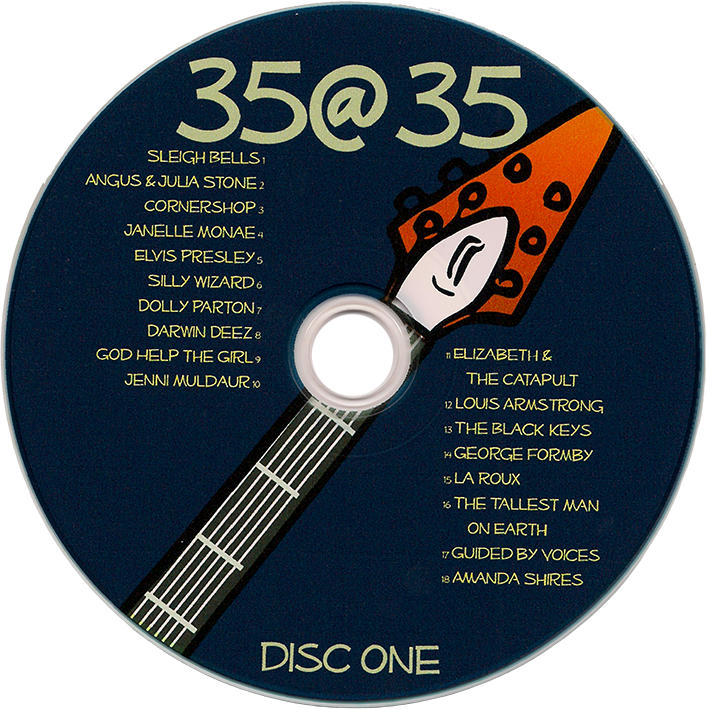
Disc 1
01
Sleigh Bells -
Rill Rill
02
Angus & Julia Stone -
Black Crow
03
Cornershop -
Brimful of Asha
04
Janelle Monae -
Tightrope
05
Elvis Presley -
Suspicious Minds
06
Silly Wizard -
The Queen Of Argyll
07
Dolly Parton -
Baby I'm Burning
08
Darwin Deez -
Constellations
09
God Help the Girl -
God Help the Girl
10
Jenni Muldaur -
You're Breaking Me Up
11
Elizabeth and the Catapult -
Complimentary Me
12
Louis Armstrong -
A Kiss To Build A Dream On
13
The Black Keys -
Tighten Up
14
George Formby -
Leaning On A Lamp Post
As a missionary in Scotland we met a musician who brought out his ukulele banjo during a visit. I had never seen or heard of one before, and the whole experience of him singing old tunes felt completely new and unexpectedly fun.
In the UK, a well-known ukulele banjo player was George Formby, who had lived decades earlier. This Scot played us what felt like an endless run of Formby classics, and I was hooked. Listening more closely later, I started to wonder if the woman in "Leaning On A Lamp Post" actually knew he was waiting there for her.
The next time we were in town, I asked a local record shop if they had any George Formby albums I could take home. They didn't have any in stock, but they offered to order some, so I placed an order and picked them up a few weeks later. That was all it took.
In the UK, a well-known ukulele banjo player was George Formby, who had lived decades earlier. This Scot played us what felt like an endless run of Formby classics, and I was hooked. Listening more closely later, I started to wonder if the woman in "Leaning On A Lamp Post" actually knew he was waiting there for her.
The next time we were in town, I asked a local record shop if they had any George Formby albums I could take home. They didn't have any in stock, but they offered to order some, so I placed an order and picked them up a few weeks later. That was all it took.
15
La Roux -
Bulletproof
16
The Tallest Man on Earth -
A Lion's Heart
17
Guided by Voices -
Teenage FBI
18
Amanda Shires -
Put Me To Bed
I first heard Amanda Shires on Whole Wheat Radio, and then followed her through recordings of shows all over the country. For a stretch she performed with Rod Picott and shared those concerts online, which made it easy to keep up with them from a distance.
One I returned to often was their performance at The Cactus Cafe in Austin, Texas, on December 10, 2009.
It was a small room, and there was as much talking as playing. They sang on each other's songs and told stories about life on the road, including where to find the best thrift store clothes. There were also bad riddles.
One I returned to often was their performance at The Cactus Cafe in Austin, Texas, on December 10, 2009.
It was a small room, and there was as much talking as playing. They sang on each other's songs and told stories about life on the road, including where to find the best thrift store clothes. There were also bad riddles.
19
Lady GaGa -
Poker Face - Acoustic Live
20
Lady Gaga -
Honest Eyes - Acoustic Live
These last two tracks are hidden on the CD version of this mix.
This recording is Lady Gaga performing on the Howard Stern Show with no backing band. Her vocals shine here.
This recording is Lady Gaga performing on the Howard Stern Show with no backing band. Her vocals shine here.
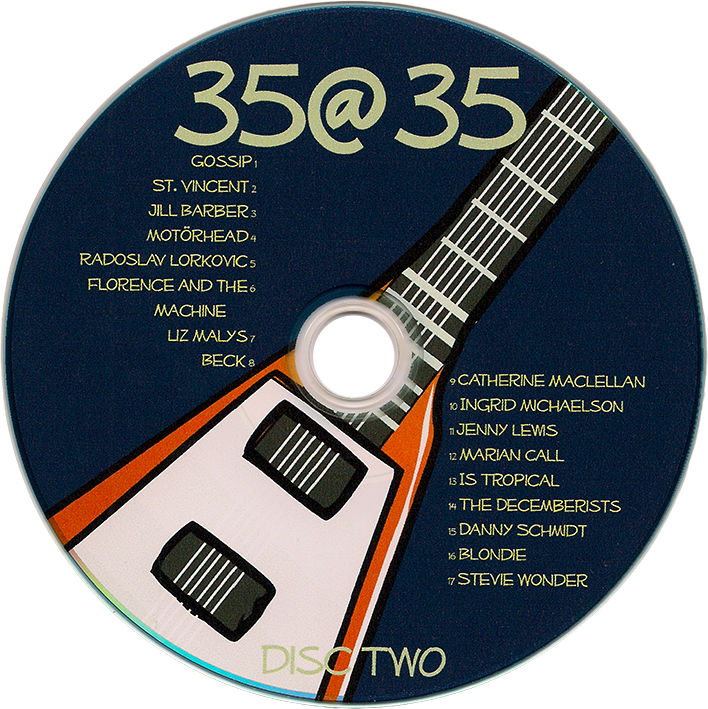
Disc 2
01
Gossip -
Heavy Cross
02
St. Vincent -
Save Me From What I Want
03
Jill Barber -
Oh My My
04
Motorhead -
Ace of Spades
Leading up to this mixtape I watched the documentary Lemmy (2010), about a man who lived in a small two-bedroom apartment in Los Angeles because it kept him close to his favorite bar and the people he cared about. The Rainbow Bar was part of his world, but so was his extensive World War II memorabilia collection and the deep knowledge he carried about that era. One of my favorite scenes shows him in a record store, genuinely excited to find a Beatles box set featuring their recordings in the original mono format. The Beatles were an early inspiration for him. He saw them live at the Cavern Club when he was 16 and later taught himself guitar by playing along to Please Please Me. It's hard to trace the style from early Beatles harmonies to Ace of Spades, but Lemmy definitely felt it.
The documentary also shows his love of gambling. He preferred slot machines over dice or cards, but joked that slot machines didn't make for good lyrics. Spinning fruit just isn't cool enough.
The documentary also shows his love of gambling. He preferred slot machines over dice or cards, but joked that slot machines didn't make for good lyrics. Spinning fruit just isn't cool enough.
05
Radoslav Lorkovic -
In the Dark With You
06
Florence And The Machine -
Dog Days Are Over
07
Liz Malys -
At First Sight
08
Beck -
Guns in the Sky
In 2009 Beck started something called Record Club. He'd get a group of friends in a room full of instruments, pick a classic album, record the whole thing in one day, and post the videos online for free. I found them late one night on my laptop and stayed up way too long.
I love watching music get made. Seeing someone try an idea, throw it out, and try again is as fun for me as the finished song. Record Club was all of that, including the bad takes and the laughing when something finally worked.
They did The Velvet Underground, Leonard Cohen, and a few others, but my favorite was INXS's Kick. It was already a great album, and it was fun hearing other people take it apart. That's also where I first heard St. Vincent. I went looking for everything she'd done right after, and she's on this mix too.
The Leonard Cohen session is how I got into Devendra Banhart, who shows up on a later mix.
I love watching music get made. Seeing someone try an idea, throw it out, and try again is as fun for me as the finished song. Record Club was all of that, including the bad takes and the laughing when something finally worked.
They did The Velvet Underground, Leonard Cohen, and a few others, but my favorite was INXS's Kick. It was already a great album, and it was fun hearing other people take it apart. That's also where I first heard St. Vincent. I went looking for everything she'd done right after, and she's on this mix too.
The Leonard Cohen session is how I got into Devendra Banhart, who shows up on a later mix.
09
Catherine MacLellan -
Take A Break
10
Ingrid Michaelson -
Be OK
11
Jenny Lewis -
Acid Tongue
I've been making mixes since the 80s. The first ones were cassettes recorded off KTMT and Rick Dees' Weekly Top 40. I'd call the station to request a song, then sit by the tape deck waiting, hoping to hit record fast enough to only miss the first few seconds.
I didn't own an Atari or a Nintendo, so I played at friends' houses. The Wizard (1989) was as close as I got to owning one. Watching it now, it's a feature-length commercial, but at the time it was unbearably cool.
It took me years to figure out that the girl from The Wizard was Jenny Lewis. By then I already had her records on repeat, and "Acid Tongue" was the one I kept going back to. Turns out the best thing in that movie wasn't the Power Glove.
I didn't own an Atari or a Nintendo, so I played at friends' houses. The Wizard (1989) was as close as I got to owning one. Watching it now, it's a feature-length commercial, but at the time it was unbearably cool.
It took me years to figure out that the girl from The Wizard was Jenny Lewis. By then I already had her records on repeat, and "Acid Tongue" was the one I kept going back to. Turns out the best thing in that movie wasn't the Power Glove.
12
Marian Call -
I'm Yours
I first heard Marian Call on Whole Wheat Radio. Her songs were pretty stripped down, and sometimes one of the instruments was a typewriter.
Not long after, she announced a tour in 2010 where she would drive from Alaska and play shows in every state. When she made it to Utah in July, we went.
The concert was in the backyard of someone I had never met. It was just a group of people who had signed up for Marian's email list and showed up when they heard she would be passing through. It was a warm summer night, and the band was Marian and a guitarist. At one point the typewriter made an appearance.
There was a potluck before the show, and I tried strawberry and serrano gelato for the first time.
Not long after, she announced a tour in 2010 where she would drive from Alaska and play shows in every state. When she made it to Utah in July, we went.
The concert was in the backyard of someone I had never met. It was just a group of people who had signed up for Marian's email list and showed up when they heard she would be passing through. It was a warm summer night, and the band was Marian and a guitarist. At one point the typewriter made an appearance.
There was a potluck before the show, and I tried strawberry and serrano gelato for the first time.
13
Is Tropical -
The Greeks
14
The Decemberists -
Rox In The Box
15
Danny Schmidt -
Stained Glass
Danny Schmidt is exactly what Whole Wheat Radio was all about.
16
Blondie -
Sunday Girl [French Version]
17
Stevie Wonder -
Superstition
Rainbow Theatre, London, January 31, 1974. If you only know the album version, this one takes the long way around.